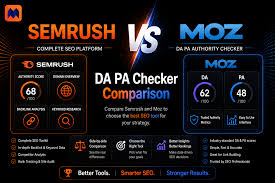

SEO today is less about guessing and more about measuring. Every successful website on search engines relies on understanding authority, trust, and backlink strength. One of the most widely used systems for this is Domain Authority (DA) and Page Authority (PA), developed by Moz.
A Moz DA PA Checker is a tool that helps users instantly analyze these authority metrics for any website or webpage. Instead of manually reviewing backlinks, traffic signals, and trust indicators, SEO professionals use DA and PA as quick filters to evaluate website quality.
This article explains how DA PA checkers are used in real SEO workflows, why they matter, and how they help improve ranking performance in practical situations.
What a Moz DA PA Checker Actually Measures
A Moz DA PA Checker evaluates two main SEO signals:
- Domain Authority (DA): overall strength of a website
- Page Authority (PA): strength of a specific page
But in real usage, it goes beyond just numbers. A good DA PA tool also analyzes:
- Backlink quality
- Referring domains
- Spam Score
- Link distribution patterns
- Domain trust signals
- Page-level SEO strength
Instead of focusing on one factor, it combines multiple signals into a single simplified SEO snapshot.
Why SEO Professionals Still Rely on DA and PA
Even though search engines do not directly use DA or PA, SEO experts still depend on them because they help answer one critical question:
“Is this website strong enough to trust for SEO work?”
DA and PA are widely used because they:
- Save time during website evaluation
- Help compare multiple domains quickly
- Support backlink decision-making
- Reduce risk in SEO campaigns
In short, they act as a fast filtering system for authority.
How DA PA Checker Is Used in Real SEO Workflows
Let’s break down how professionals actually use this tool in daily SEO operations.
1. Backlink Quality Filtering
Before placing a backlink, SEO users typically check:
- Domain Authority (DA)
- Page Authority (PA)
- Spam Score
- Referring domains
This helps filter out weak or unsafe websites.
Common real-world filtering logic:
- DA 50+ → strong authority target
- DA 20–50 → moderate value
- DA below 20 → usually low priority
However, context always matters more than raw numbers.
2. Competitor Strength Mapping
Instead of manually analyzing competitor SEO, marketers use DA PA checkers to quickly understand:
- Who dominates search rankings
- How strong competitor domains are
- Which pages have the highest authority
This allows SEO teams to reverse-engineer:
- Link strategies
- Content strength
- Domain authority gaps
It’s a shortcut to understanding competition.
3. Guest Posting Decisions
One of the most common uses of DA PA tools is evaluating guest posting sites.
Before publishing content, SEO professionals check:
- DA of the domain
- PA of the target page
- Spam Score
- Relevance to niche
This ensures backlinks come from valuable and safe sources.
4. SEO Audit and Website Health Checks
DA PA checkers are also used in SEO audits to evaluate:
- Overall domain strength
- Page performance variations
- Backlink growth or loss
- Authority distribution across pages
This gives a quick snapshot of SEO health without deep technical crawling.
Understanding Domain Authority in Practical Terms
Domain Authority is often misunderstood as a ranking guarantee. In reality, it is a comparative strength indicator.
A high DA website usually has:
- Strong backlink profile
- Consistent SEO performance
- Multiple referring domains
- Established trust signals
But DA alone does not guarantee rankings.
What DA really tells you:
- How strong a domain is compared to others
- How difficult it may be to outrank it
- Whether a website is worth targeting for backlinks
It is a directional metric, not an absolute rule.
Page Authority: The More Actionable Metric
While DA gives a broad overview, Page Authority is often more useful in real SEO execution.
PA helps identify:
- Which pages rank better
- Which content is performing well
- Which pages attract backlinks
Why PA matters more in content SEO:
Google ranks pages, not domains.
So even:
- Low DA sites can rank with high PA pages
- Strong DA sites may have weak pages that don’t rank
This makes PA a more tactical SEO metric.
Spam Score: The Safety Layer Most People Ignore
Spam Score is one of the most important risk indicators in a DA PA Checker.
It identifies websites that may have:
- Manipulative backlink patterns
- Low-quality SEO structure
- Suspicious linking networks
- Thin or duplicate content
Why this matters:
A website with:
- High DA
- But high Spam Score
can still be dangerous for backlinks.
SEO professionals usually prioritize:
- Clean backlink profile
- Low Spam Score
- Natural link growth
over raw authority numbers.
Bulk DA PA Checking for Large SEO Campaigns
Bulk analysis is essential for agencies and advanced SEO workflows.
Instead of checking one site at a time, bulk tools allow:
- Hundreds of URLs analyzed instantly
- Backlink lists filtered efficiently
- Competitor datasets processed at scale
- Outreach targets sorted quickly
Real workflow example:
An SEO team may:
- Collect 500 guest post sites
- Run bulk DA PA check
- Filter results by DA > 40
- Remove high Spam Score domains
- Keep only strong backlink opportunities
This turns hours of manual work into minutes.
Referring Domains: The Real Authority Indicator
Referring domains often matter more than raw backlink count.
Why?
Because search engines trust diversity.
Example:
- 100 backlinks from 1 site → weak signal
- 100 backlinks from 100 sites → strong signal
A strong SEO profile usually has:
- Diverse referring domains
- Natural link distribution
- Industry-relevant sources
This is a key factor behind rising DA.
How to Increase DA in a Sustainable Way
Improving Domain Authority is not about shortcuts or automation. It requires consistent SEO effort.
1. Publish Link-Worthy Content
Best content types include:
- Research-based articles
- Industry guides
- Tools and resources
- Case studies
These naturally attract backlinks.
2. Earn Editorial Backlinks
Focus on links from:
- Blogs
- News sites
- Industry websites
- Authority platforms
Editorial links carry the highest value.
3. Improve Internal Linking Structure
Internal linking helps:
- Pass authority between pages
- Improve indexing
- Strengthen weak pages
4. Maintain Technical SEO Health
Ensure:
- Fast loading speed
- Mobile optimization
- Clean site structure
- Proper indexing
5. Remove Toxic Backlinks
Regular audits help eliminate:
- Spammy links
- Irrelevant domains
- Low-quality sources
Common Misuse of DA PA Tools
Many beginners misuse DA PA metrics in SEO decisions.
Mistake 1: Using DA alone for decisions
DA without context is misleading.
Mistake 2: Ignoring relevance
A high DA unrelated site may not help rankings.
Mistake 3: Buying backlinks blindly
Some sites artificially inflate authority.
Mistake 4: Overlooking PA
Pages often matter more than domains.
Future of DA PA Checker Tools
SEO tools are evolving rapidly. Future DA PA systems are expected to include:
- AI-driven authority scoring
- Real-time backlink updates
- Predictive ranking analysis
- Smarter spam detection systems
- Competitive intelligence dashboards
The industry is moving toward more intelligent, real-time SEO evaluation systems.
Conclusion
A Moz DA PA Checker is a practical SEO decision-making tool that helps evaluate website authority, backlink strength, and ranking potential in seconds. Instead of manually analyzing complex SEO signals, users can rely on Domain Authority, Page Authority, Spam Score, and referring domain data to guide their strategy.
When used correctly, it helps SEO professionals:
- Choose better backlink opportunities
- Analyze competitors efficiently
- Improve website authority over time
- Reduce SEO risks
Ultimately, DA and PA are not final answers—they are guiding signals. Combined with strong content, ethical link building, and technical SEO, they become powerful tools for long-term search engine success.